 HiWord.AI
Play & learn · 03
You Describe, AI Guesses: explain it with the English you know
How would you describe an umbrella without saying “umbrella”? Start with when you use it, then add where you hold it. The practice happens as you make your meaning clearer.
- Currently available on iOS
- 3 words per set · no countdown
- Speak or type your clues
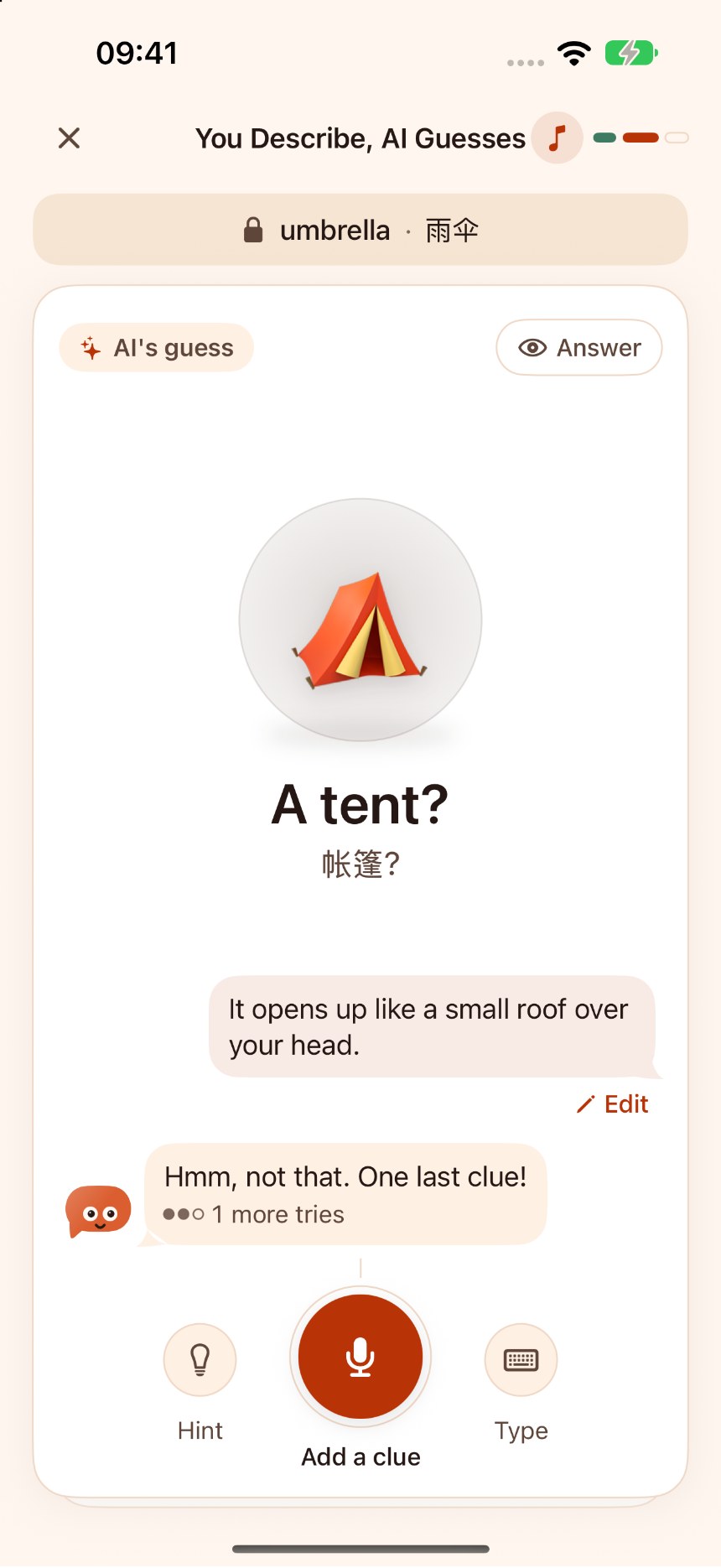
The short answer
You Describe, AI Guesses is HiWord’s English description game, currently available on iOS. You see a secret word and give English clues without saying the answer. Each word allows up to three valid guesses, using voice or typing, with no countdown. The task practises explaining, adding detail and rephrasing with familiar vocabulary; it is not a grammar or pronunciation test.
How do you play You Describe, AI Guesses?
- Open the game in HiWord on iOS.A set contains three words. This web page is a guide; the game itself currently requires the iOS app.
- Read the secret word and think of an English clue.Describe its purpose, appearance, location or a situation in which you use it. Do not say the target word or give the answer in Chinese.
- Speak or type.Hold to speak, check the recognised text and send the clue for a guess. Correct a transcription error before sending; typing is available when speaking is inconvenient.
- Add a distinguishing clue if the guess is wrong.Each word allows up to three valid guesses. Blocked answer leaks, silent recordings and network failures do not count as valid guesses.
- Read the model expression.After success or a reveal, an example expression is available to read and listen to. You can reveal the answer yourself, finish a set or choose to play another three words.
What makes a clue more useful?
Teaching example · actual AI guesses vary
Secret word: umbrella
You: “You use it when it rains.”
AI: “A raincoat?”
You: “You hold it above your head.”
AI: “An umbrella?”
The first clue provides a situation. The second adds a feature that helps distinguish an umbrella from a raincoat. Clearer does not have to mean longer.
A correct first guess is welcome too. An incorrect guess does not automatically mean your English was wrong: several objects may fit the clue, or transcription and model judgement may be involved. Check the recognised words before deciding whether to rephrase or add information.
Why practise saying it another way?
In a real conversation, the precise word is not always available immediately. If you can say “the thing you use to charge your phone,” you can keep communicating even when charger does not come to mind.
This game asks you to choose words, construct a description and respond to what the listener understood. Compared with selecting a meaning from options, it gives you more opportunities to organise language yourself. With no countdown, you can pause to find a simple explanation.
| Angle | Sentence starter | What to add |
|---|---|---|
| Purpose | You use it to… | The action it helps you perform |
| Setting | You see it in… | A place or situation |
| Feature | It has… | A shape, part or distinctive detail |
| Contrast | It is like…, but… | How it differs from the last guess |
These are practice suggestions, not promised learning outcomes. A correct AI guess means the clues were sufficient for this particular guess. It does not certify grammar, pronunciation or how every human listener would interpret the same description.
How can you get more from three words?
Say it once, then say it differently
- Begin with one simple English clue rather than an elaborate sentence.
- After a miss, add one important distinction instead of repeating the same clue three times.
- Read the model expression at the end, listen to it and say it aloud.
- Look away and explain the object with a different sentence pattern.
- Continue with shadowing for pronunciation feedback or AI conversation for a longer exchange.
Typing lets you focus on composing a clue. When you want spoken practice, say the idea aloud as well. Hints can help you get started; afterwards, hide them and try again. The useful habit is having another way to communicate when a word is missing.
Common questions
Can I play You Describe, AI Guesses on the web?
The game is currently available in HiWord on iOS. This is its bilingual web guide. WordStrike and Meteor can be played directly on the web.
Do I need perfect sentences?
No. Start with simple English clues rather than waiting for a perfect sentence. Avoid saying the answer or substituting Chinese for the clue. Guessing results are not grammar scores; use the model expression afterwards for further practice.
Are there only three attempts per word?
There are up to three valid guesses per word. Silent recordings, blocked answer leaks and network failures do not count as valid guesses. You can edit a clue or reveal the answer yourself.
Does a correct guess mean my pronunciation was good?
Not necessarily. Speech is transcribed and the AI guesses from the clues; guessing correctly is not a pronunciation assessment. Continue with HiWord shadowing if you want pronunciation feedback.
Sources and editorial note
Rules checked against the HiWord implementation on October 25, 2026. Web images show actual local gameplay; the iOS image shows a demonstration round rendered by the app. Learning suggestions describe practice methods, not validated product outcomes. Written by the HiWord team.
When the exact word goes missing, try explaining it.
Play a little, then return to learning with one specific thing to work on.
View HiWord on the App Store